Strategy in practice / Project documentation
Job Market Analysis
Analyze 2025 automation job postings to compare core skills, preferred skills, title trends, and role categories.
The business perspective
Challenge, decisions,
and delivery.
Business challenge
Identify recurring skill expectations and role patterns in 2025 AI automation and process-automation job postings.
Role & scope
Analyzed a dataset of job postings to understand the target career path and shape the next portfolio projects.
Decisions & tradeoffs
Compared core versus preferred skills, examined common job-title terms, and distinguished AI automation from process automation requirements.
Outputs & deliverables
Four documented visualizations: core skills, preferred skills, job-title trends, and skill distribution across AI and process automation roles.
The engineering perspective
Implementation
& artifacts.
A. Purpose
This analysis distills real job-market data from AI automation and process-automation roles from 2025 into clear patterns. It identifies which skills employers consistently expect, how roles are evolving, and where my own portfolio aligns with industry demand. By analyzing trends across different levels, toolsets, and automation frameworks, this page demonstrates a data-driven approach to understanding my target career path and shaping the projects I build next.
Together, the visualizations on this page show that modern AI automation roles are fundamentally engineering-adjacent, even when built on low-code platforms. Core automation tools like Zapier and n8n form the backbone of the field, supported by strong expectations around APIs, webhooks, and data handling. Preferred skills such as JavaScript, Python, cloud platforms, and AI-driven workflows reveal how employers differentiate strong candidates from baseline-qualified ones.
The comparison between AI automation and process automation further clarifies where LLM-centric skills diverge from traditional workflow orchestration, reinforcing how my portfolio targets the overlap between both domains while leaning into where the market is clearly moving next.
Core Skills
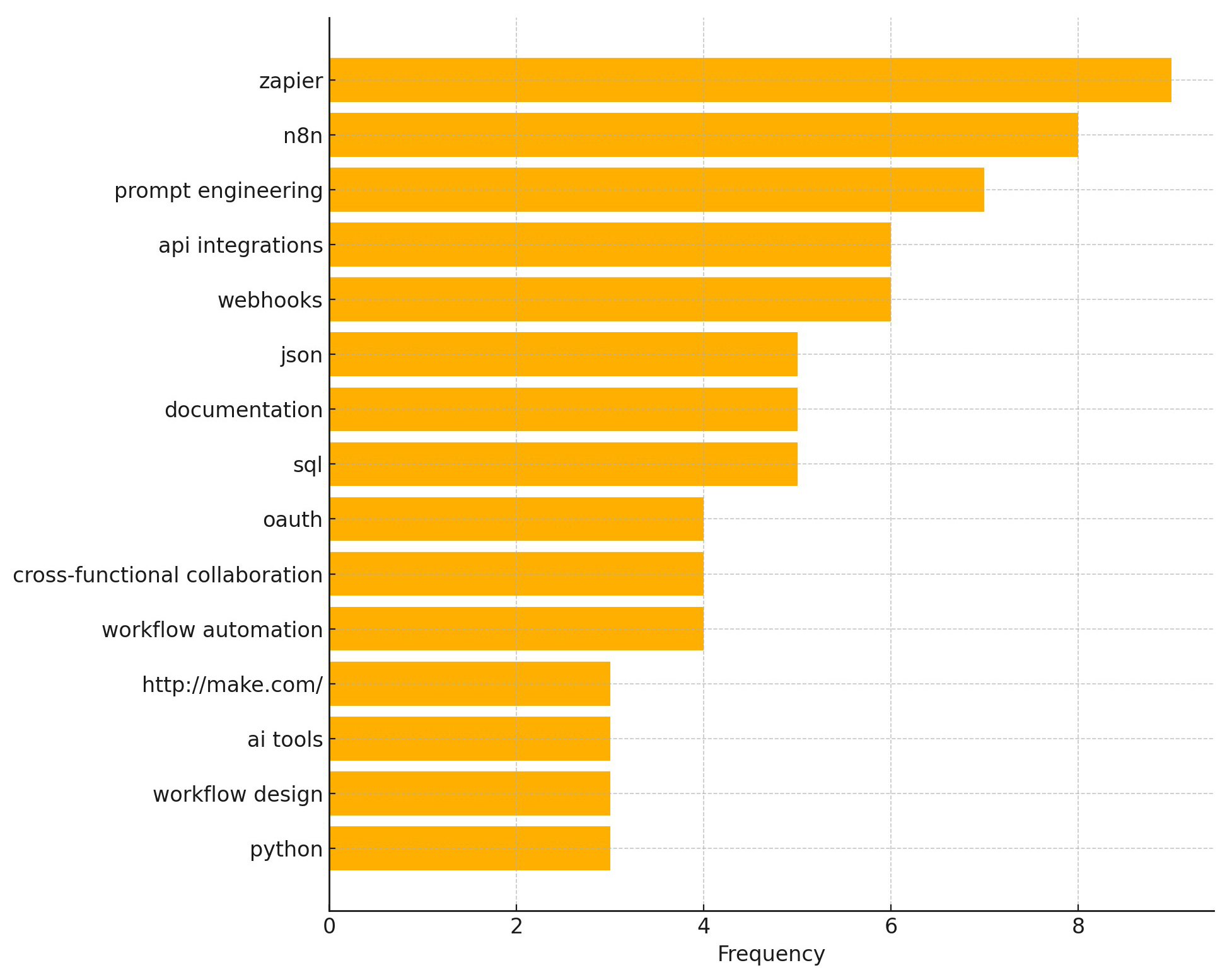
This chart shows which skills appeared most often across my dataset. Zapier and n8n lead by a wide margin, demonstrating that automation platform experience is the core requirement in this field. API-based skills, such as API integrations, webhooks, JSON, and OAuth, form the next major cluster, showing that companies want people who can connect systems and make automations reliable. SQL, documentation, and cross-team collaboration round it out.
Preferred Skills
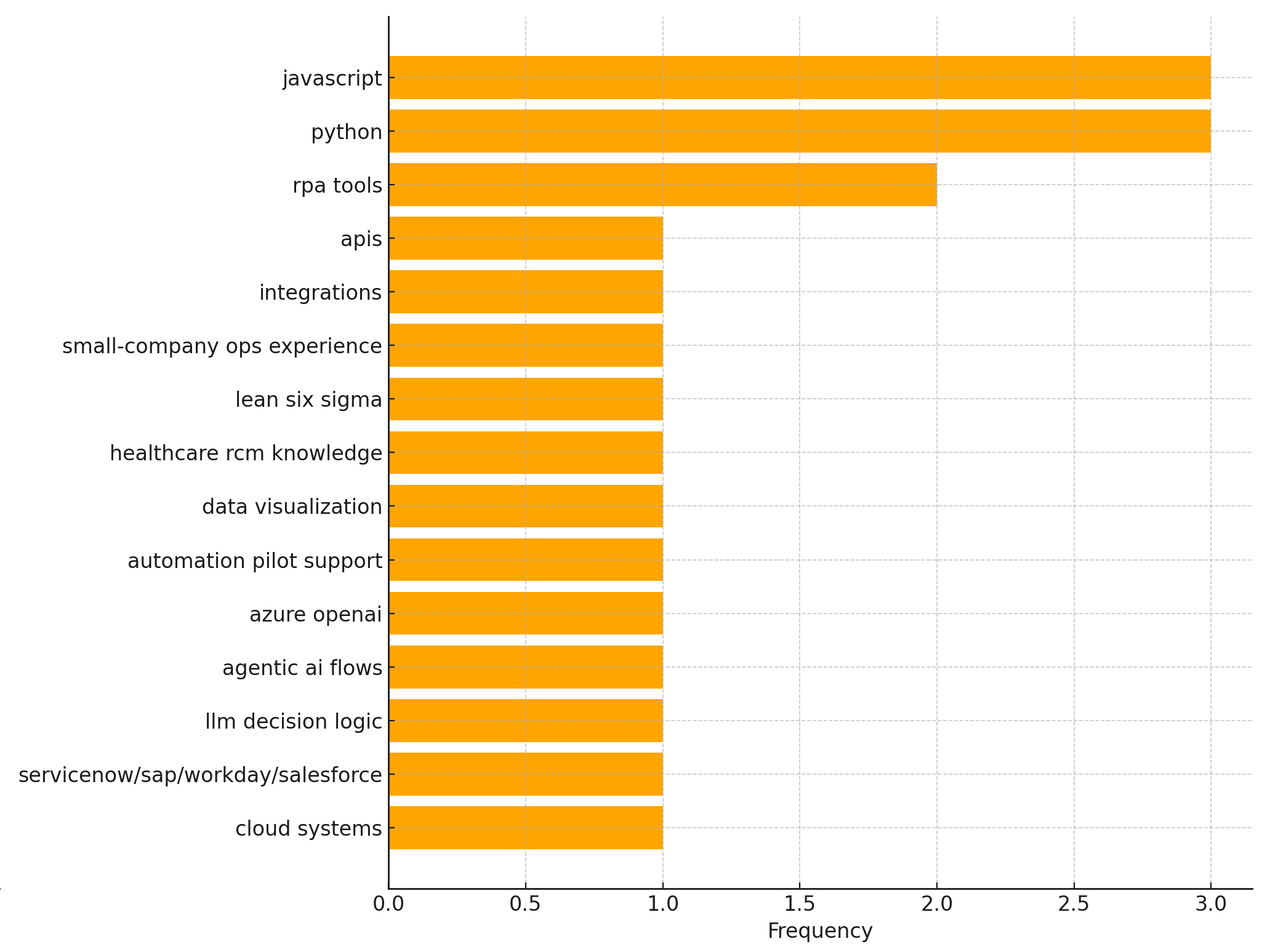
This chart highlights the preferred skills employers look for beyond the core requirements. JavaScript and Python lead the list, showing that light scripting remains a strong advantage even in low-code automation roles. The rest of the preferred skills cluster around RPA tools, cloud platforms, enterprise systems (ServiceNow, Workday, Salesforce), and AI-driven capabilities like agentic flows or Azure OpenAI. These aren't mandatory, but they clearly signal where the field is heading and what elevates a candidate from "qualified" to "top-tier."
Job Title Trends
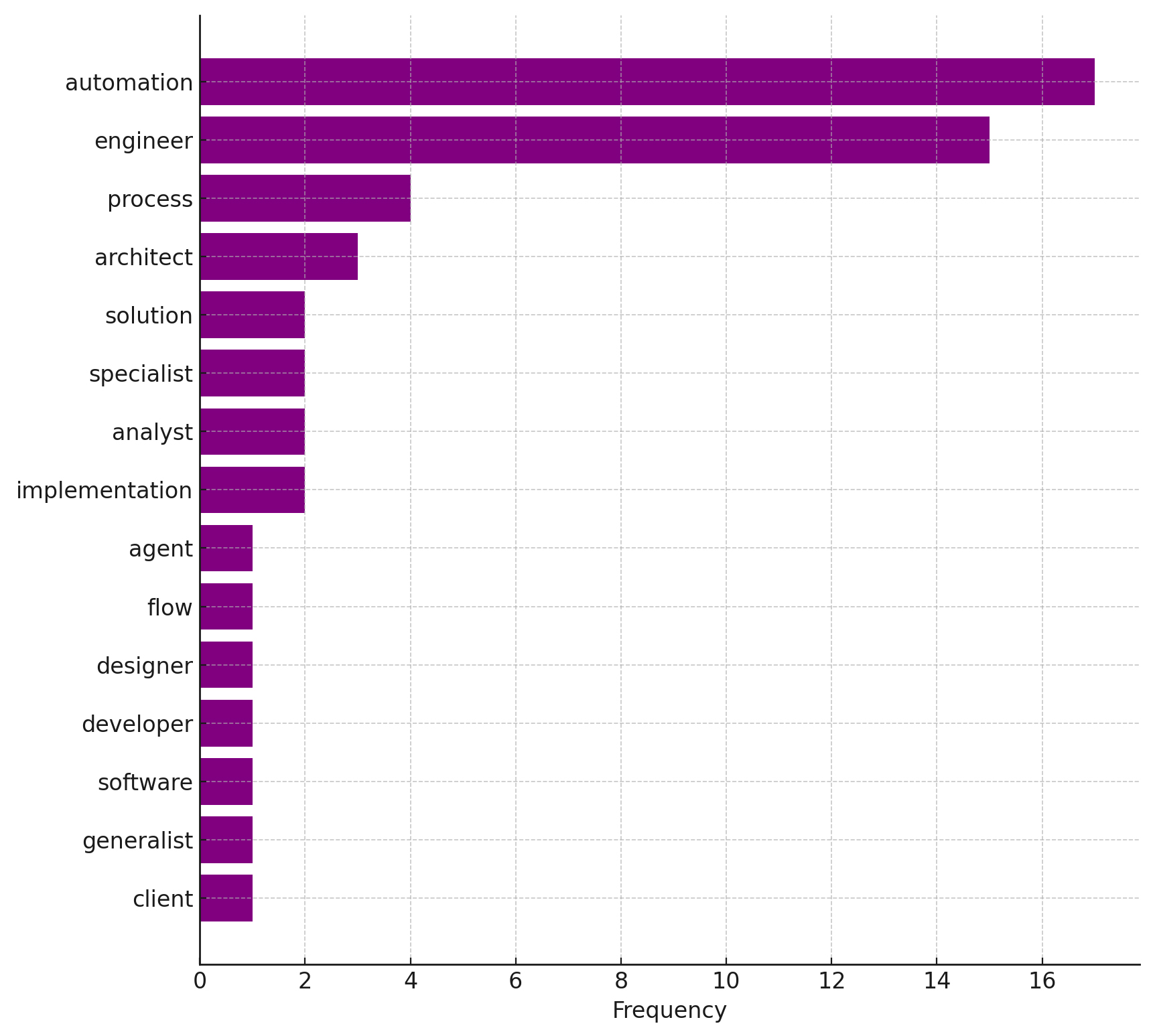
This chart shows the most common words used in job titles across the AI and automation roles I analyzed. Automation and Engineer dominate by a huge margin, confirming that the market overwhelmingly frames these roles as engineering-adjacent, even when they rely on low-code tools. Titles like Architect, Specialist, Analyst, and Implementation appear less frequently but form a clear secondary tier.
Skill Distribution Across AI
vs. Process Automation Roles
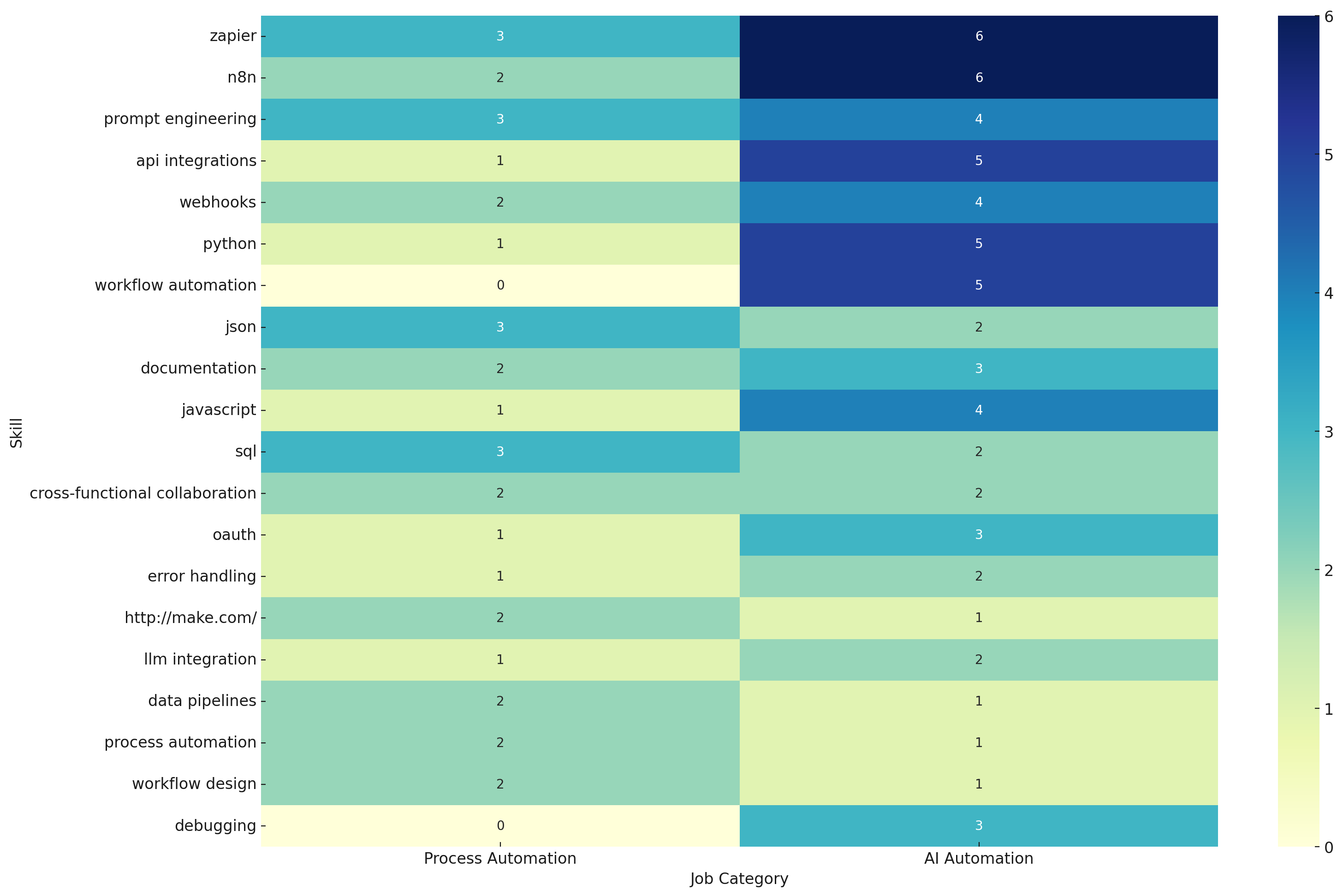
This heatmap compares how the top automation skills appear across two categories: AI Automation and Process Automation. A few patterns stand out immediately. Tools like Zapier, n8n, and core scripting languages remain essential across both roles.
AI Automation roles lean more toward LLM-driven skills such as prompt engineering, agent logic, and API integrations, while Process Automation roles show stronger emphasis on SQL, workflow mapping, and enterprise system orchestration.